












OpenAI: The Cathedral in the Desert
OpenAI's $122 billion funding round exposes the existential crisis of generative AI. From the death of Sora 2 to burning $15M daily, an in-depth analysis of Silicon Valley's most expensive bet—and why it might not pay off
How the $122 billion funding round reveals the existential crisis of generative artificial intelligence
March 24, 2026 was the day that stripped OpenAI bare. As the sun set over San Francisco, the company simultaneously announced two antithetical pieces of news: on one hand, a record-breaking $122 billion funding round — the largest in Silicon Valley history; on the other, the death of Sora 2, the AI video platform that had absorbed $1 billion in investments and partnerships (including the Disney deal) in just six months of life.
This coincidence is not a case of bad timing. It is the revelation of an uncomfortable truth: OpenAI is not raising capital to conquer the future, but to survive the present. And the price of survival is becoming unsustainable.
The Paradox of Easy Money
The numbers from the $122 billion round sound like a victory: an $852 billion post-money valuation, participation from SoftBank (which took out a $40 billion loan to finance its own $30 billion investment), Microsoft, Nvidia, and even $3 billion raised from retail investors through private banks.
But this abundance of capital hides a deeper problem: OpenAI is burning money faster than it can create value. According to leaked projections, the company expects operating losses of $74 billion by 2028 and a total of $140 billion in accumulated losses between 2024 and 2029. HSBC estimates that another $207 billion in financing will be needed by 2030, even after the IPO planned for this year.
In other words: every dollar raised today is a loan against an increasingly improbable future.
Sora 2: The Symbol of a Failed Strategy
The closure of Sora is not just a product failure. It is the emblem of an "AI slop economy" that has shown its structural limits. Sora was burning $15 million per day in computational costs — figures that former Fidelity manager George Noble called "absurd" for a product generating questionable-quality deepfakes and copyright threats.
But the real problem is not the cost. It is the lack of competitive moat. Trevor Harries-Jones of Render Network explained with clarity: "There's so much choice in the market that switching from one model to another is extremely simple. If your model isn't the best at something specific, you can't retain users".The numbers confirm: after a peak of 6.1 million downloads in November 2025, Sora crashed to 1.1 million by March 2026, while competitors like Google Veo 3 and Kling gained market share. OpenAI had no sustainable technological advantage — just a famous name and a lot of GPUs.
Worse still, the sudden closure dragged down the $1 billion Disney deal, announced three months earlier with great fanfare. Disney was informed less than an hour before the public announcement, while teams were still collaborating on active projects. This way of operating is not just corporate rudeness: it is the sign of a company in a liquidity crisis that must cut off its legs to save its body.
The Infrastructure Trap
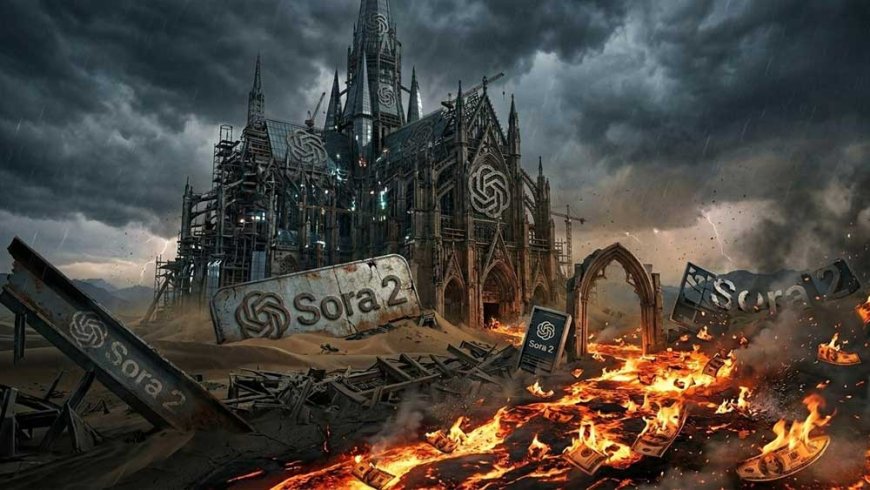
OpenAI is building a "cathedral in the desert." It has commitments for $1.4 trillion in data centers and infrastructure over the coming years, but what will they be for if the products don't monetize?
The "flywheel" strategy (more compute = better models = more users = more revenue = more compute) only works if real demand grows at the pace of computational capacity. Instead, an MIT study found that 95% of companies that invested $30-40 billion in GenAI have seen no return. Enterprise adoption is slow, distrustful, and increasingly cost-conscious.While OpenAI burns $2 billion per month, competitors like Meta (with its open-source Llama models) and Google are eroding the technological advantage.
Anthropic's Claude 3.5 Sonnet beats GPT-4 on coding at a quarter of the cost. Google's Gemini 2.0 Flash offers comparable performance to GPT-4o at drastically lower prices.ChatGPT's web traffic share has dropped from 86.7% to 64.5% in 12 months. It is no longer the only game in town.
The SoftBank Bubble
SoftBank's entry as co-lead of the round is perhaps the most alarming signal. SoftBank had to take out an unsecured $40 billion loan with a 12-month maturity to finance its own investment. This means lenders expect OpenAI to IPO by 2026 and for that IPO to be a success. If it were delayed or disappointed, the pressure on SoftBank (and by extension on OpenAI) would be catastrophic.
This financial structure dangerously recalls the dot-com bubble: easy money financing speculative bets on speculative bets.
The "Side Quest" Problem
The decision to close Sora, as reported by The Verge, came after Fidji Simo (CEO of AGI deployment) told staff: "We cannot miss this moment because we are distracted by side quests. We absolutely have to nail productivity, especially on the business front".
But this rhetoric of "focus" masks a more disturbing reality: OpenAI has spent the last two years chasing every possible trend — social media, browser, web search, video generation, "adult mode" for ChatGPT — without finding a profitable business model for any of them.
Now, the company is betting everything on autonomous AI agents. But what guarantees that this isn't just the last "side quest" before failure? If agents require another 5 years and another $200 billion to become profitable (and no one knows), investors' patient capital may run out first.
The Lesson for the Industry
OpenAI's story in 2026 is a case study on the limits of "growth at all costs." The company has demonstrated that it is possible to build impressive artificial intelligence models, but not that it is possible to monetize them sustainably.
The IPO planned for 2026 will be the definitive test. If the public market accepts financing billion-dollar losses until 2030 in exchange for a bet on AGI, OpenAI may survive. But if institutional investors look at the fundamentals — $2 billion monthly burn rate, increasing competition, talent exodus to Anthropic and xAI, and products closed after six months — we could witness the harshest correction in recent Silicon Valley history.
As Sam Gregory of Witness, an organization fighting deepfakes, noted: "What angers me is that in the absence of real money, real investment, real will, things only change for business reasons, not for real harm". OpenAI has normalized a world where we no longer know what is real, raised $122 billion to build cathedrals in the desert, and now asks us to trust that the next bet will be the right one.
The question every investor should ask is not whether OpenAI will build AGI. It is whether it can afford to get there before running out of money.
What's Your Reaction?