



























BIG TOBACCO 2.0: How Silicon Valley Became the New Philip Morris
The Verdict That Will Change Social Media Forever.Meta and Google found liable for addicting minors. The secret memos, the Big Tobacco and opioid parallels, and why 2025 marks the end of tech innocence
The Same Trap, The Same Playbook
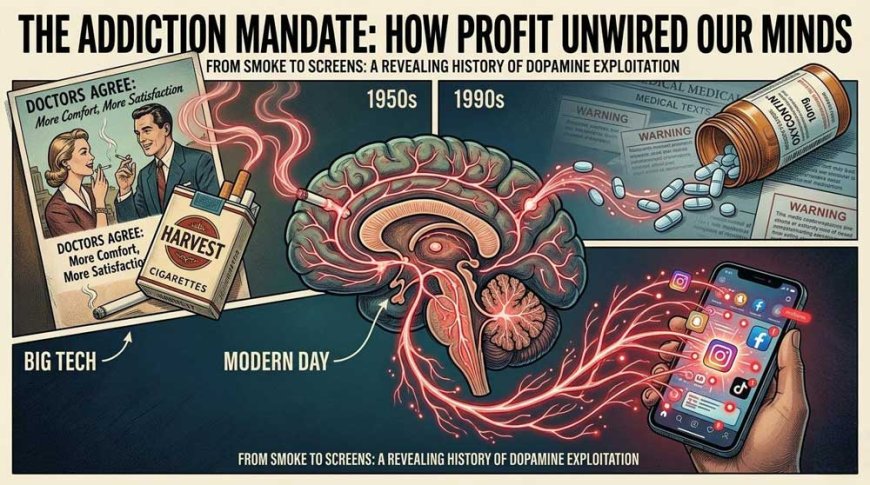
In 1998, Big Tobacco paid $246 billion for lying about cigarettes. Today it’s Meta and Google’s turn: a Los Angeles jury ruled that social platforms aren’t "neutral tools" but products engineered to create addiction—just like "light" cigarettes were for tobacco companies.
The comparison isn’t rhetorical. It’s historical.
The Meta Papers: The New Hidden Truth
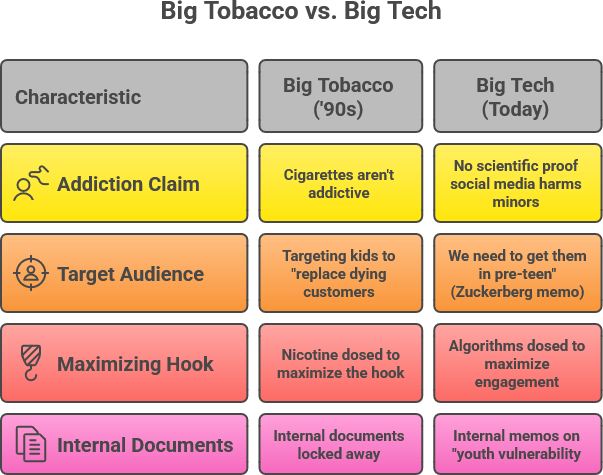
Just like Big Pharma with opioids (think Purdue and OxyContin), Meta had internal proof of the damage and ignored it. The memos shown in court weren’t system bugs: they were intentional product features.
Zuckerberg knew 11-year-olds returned to Instagram 4 times more than competing apps. Not by accident: because the interface was built around the neural vulnerabilities of pre-teens, no differently than tobacco companies studied brain receptors.
The difference? Cigarettes kill in 40 years. Social media creates addiction, depression, and suicidal thoughts at age 11.
From "Safe Harbor" to "Strict Liability"
For decades, Silicon Valley hid behind Section 230—the legal immunity protecting platforms from user content. It was their shield, just as the FDA was for Big Pharma before the opioid crisis.
But the Los Angeles verdict changes the game: we’re no longer talking about content, but design. It doesn’t matter what users post; what matters is how the algorithm is built to glue kids’ brains to the screen.
This shifts liability from editorial (like a newspaper) to defective product (like a car with broken brakes or an untested drug).
Big Pharma: The Lesson Never Learned
When Purdue Pharma marketed OxyContin promising it was "non-addictive," doctors and patients believed them. Result: 500,000 deaths and $6 billion in damages.
Meta and Google are repeating the same script:
-
Scientific denial: "No evidence"
-
Aggressive marketing: Targeting minors despite age restrictions
-
Data suppression: Internal memos sealed until trial
-
Blame shifting: "Parents should monitor"
The Los Angeles jury said enough: liability lies with the manufacturer, not the vulnerable consumer.
The Point of No Return: 2,000 Cases and Counting
The $3 million damages are pocket change. Dangerous are the 2,000 lawsuits coming and the punitive sanctions the judge may still add.
If the formula is Big Tobacco’s (damages × number of victims), we’re talking hundreds of billions. Enough to force a complete redesign of social media, just as graphic warning labels reshaped the tobacco industry.
The New Label: "Dangerous for Developing Brains"
After these verdicts, we can expect:
-
Visual warnings before every infinite scroll (like lung cancer photos on packs)
-
Verified age limits with ID, not just a click (like alcohol and tobacco)
-
Dosage limits: No more than 30 minutes daily for under-16s (like controlled therapeutic regimes)
-
Black box warnings on recommendation algorithms (like psychoactive drugs)
The End of "Technological Innocence"
For 20 years, social media was treated as a freedom tool. Now they’re recognized for what they are: industrial products that alter brain chemistry for profit.
The Los Angeles verdict isn’t an accident. It’s the Master Settlement Agreement of social media—the moment an industry can no longer hide behind innovation rhetoric.
Like tobacco and opioids, the question is no longer whether to regulate, but how fast the state will act before an entire generation pays the price for their stock quotes.
Bottom line: Meta and Google have become the Philip Morris of 2025. And like Philip Morris, they’ll have to learn to do business in a world where addicting children carries a legal price, not just a moral one.
What's Your Reaction?








albertofattori
Alberto Fattori is an Italian venture capitalist, digital innovator, and entrepreneur with a pioneering spirit in technology and media. With a background in Computer Science, he began his career in the 1990s as CEO of Glamm Interactive, where he played a key role in developing cutting-edge digital platforms, including the official website of the Vatican (Vatican.va) and other prestigious web projects.
Over the decades, Alberto has remained at the forefront of innovation, blending creativity, business strategy, and technological foresight. Today, he is actively involved in venture capital, investing in disruptive startups across e-commerce, blockchain, phygital media, and AI-powered ecosystems.
As a founding force behind Nexth iTV+, he champions the concept of Phygital iTV, a seamless integration of physical and digital experiences across sectors such as Wine & Spirits, Fashion, Travel, and Education. Through his initiatives, Alberto promotes new models of interaction, economic cooperation, and international business—guided by a strong belief in Sharism over protectionism.
His vision is grounded in turning ideas into impactful realities by connecting capital, creativity, and technology across borders.