



















Robotaxi Italy: The End of Human "Highlanders"?
Robotaxi Italy: The End of Human "Highlanders"? Future of Taxis & Driver Transition. Wuhan robotaxi blockade divides Italy: drivers celebrate, but technology advances. Analysis of robotaxi status in China, USA and Europe, with 4 concrete proposals to save Italian drivers through Fleet Owner, Cooperative and Public Platform models. Between protected inefficiency and technological transition
The Wuhan Blockade: A Mirror for Italy
On March 31, 2026, dozens of Luobo Kuaipao vehicles (Baidu's robotaxi) suddenly stopped on the streets of Wuhan, emergency lights flashing, blocking traffic for hours. A technical incident without casualties, but with enormous media impact. The response from Chinese media was surprisingly balanced: many defended the vehicle halt as an "active safety strategy" rather than a malfunction.
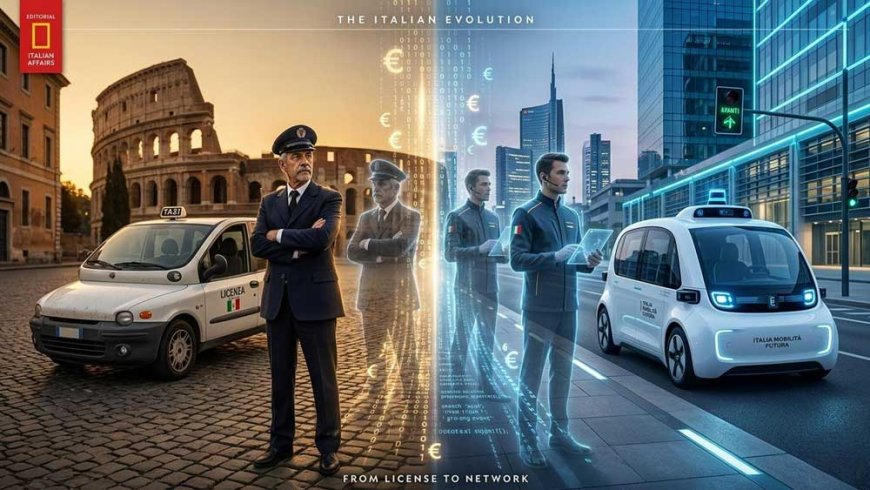
Yet when I close my eyes, I already see the Italian scene: taxi drivers in Rome, Milan, Naples doing the wave, celebrating, shouting "Here in Italy? Never!" Like the immortals in Highlander, they believe they are eternal, protected by a shield of licenses, regulations, and—above all—resistance to change.
But the truth is more complex. And harsher.
The International Reality: Myth vs. Technological Truth
China: The Running Giant (Who Stumbles)
Baidu has surpassed 20 million global rides, with active fleets in 22 cities. WeRide and Pony.ai are expanding into the Middle East and Europe. Chinese LiDAR costs are a fraction of Western ones, the supply chain is integrated, and the State funds over 60% of R&D.
But the Wuhan blockade shows the limits: the technology works, but it's not infallible. A system that stops "for safety" is better than one that causes accidents, but it's still a system failing its primary objective: moving.
USA: The Duopoly That No Longer Exists
Waymo is the only true Western success: 2,500+ vehicles, 450,000 weekly rides, expansion to 4 cities. Tesla launched its "Robotaxi" in Austin in summer 2025, but reality is disappointing: ~42 active vehicles, availability below 20%, accident rate 9 times higher than human drivers. Elon Musk promises, but doesn't deliver.
Europe: The Regulatory Labyrinth
The EU is building a unified regulatory framework for 2026, but meanwhile each nation proceeds independently. Germany and the UK have legalized Level 4 autonomous driving, but with strict standards. Chinese companies enter through local partnerships—WeRide in Leuven, Pony.ai in Luxembourg, but must face GDPR, data sovereignty, and geopolitical sensitivity.
The technological truth? Robotaxis work, but in limited contexts: geographically mapped areas, favorable weather conditions, predictable traffic. They're not yet ready for Italian chaos, with its zigzagging scooters, double-parked cars, and "decorative" road signs.
Italy: A Taxi System in a Bubble
The Paradox of Protected Inefficiency
Italy has about 25,000 taxi drivers with individual licenses, a number frozen for years under the pretext of "protecting the category." The result? A service that in many cities is:
-
Inaccessible: 30-40 minute waits at night
-
Expensive: Among the highest fares in Europe
-
Inflexible: Few shared rides, no integration with international apps
-
Technologically backward: Many drivers still refuse card payments
The Italian taxi license has become a financial asset, not a work tool. It's bought and sold at prices that in cities like Rome or Milan can exceed €200,000. Those who have it defend it tooth and nail. Those who don't, can't enter.
This system protects the few at the expense of the many. And prepares the ground for an even more violent disruption when robotaxis truly arrive.
Operational Proposals: Saving the Driver, Not the License
Italy has a choice: passively wait for technology to overwhelm it, or redesign the role of the taxi driver to make it compatible with the future. Here are concrete proposals:
1. The "Fleet Owner" Model
The human driver gets an autonomous vehicle and revalues the license over time.
-
The State or municipalities purchase robotaxi fleets
-
Current drivers receive a vehicle on loan, maintaining license ownership
-
The license transforms into "fleet management right": the driver doesn't drive, but supervises, manages maintenance, intervenes in exceptional cases
-
Income comes from a share of rides generated by the vehicle, not from direct driving
Advantage: The driver becomes a technology entrepreneur, not a replaced worker. Maintains income, gains scalability (one human can supervise multiple vehicles), and has a dignified exit path.
2. The "Transition Cooperative" Model
Drivers aggregate into cooperatives managing mixed fleets.
-
Driver cooperatives acquire robotaxis through facilitated financing
-
Mixed fleet: vehicles with human drivers for complex areas or customers needing assistance, autonomous vehicles for standard routes
-
Driver members rotate between driving (for those who want/want to earn more) and fleet supervision
Advantage: Preserves category identity, but modernizes it. Creates economies of scale that individual drivers cannot achieve alone.
3. The "Public Platform" Model
The Municipality becomes platform manager, drivers become service providers.
-
Municipalities create integrated mobility platforms (robotaxi + public transport + sharing)
-
Drivers can join as "service operators": they manage autonomous vehicles, provide customer assistance, manage maintenance hubs
-
The Municipality guarantees a minimum of rides/income, de-risking the transition
Advantage: Maintains public control over an essential service, avoiding dependence on foreign Big Tech (Uber, Tesla, Baidu).
4. The "Voluntary Withdrawal with Tech Bonus" Model
For those who don't want to transition, a dignified exit that finances new operators' entry.
-
Drivers who surrender their license receive a significant bonus (e.g., €150,000-200,000, equivalent to current market value)
-
The bonus can only be used for: starting businesses in the tech sector (robotaxi maintenance, fleet management), professional retraining, or early retirement
-
Surrendered licenses feed a fund for purchasing robotaxis by cooperatives or public administrations
Advantage: Clears the field without social conflicts, finances technological transition, avoids license concentration in few hands.
The Cultural Challenge: Getting Out of the Bubble
Italy's problem isn't just technological or economic. It's cultural. Italian taxi drivers—like many protected categories—have developed a "highlander" mentality: they believe they're immortal because they've won past battles.
But past battles don't guarantee future victories. Indeed, they make you more vulnerable: those who feel invincible don't prepare, don't adapt, don't see the opponent coming.
The Wuhan blockade is a warning: technology isn't perfect, but it's improving rapidly. Waymo already has 2,500+ vehicles
, Baidu 20 million rides
. Today's problems will be solved tomorrow. And when they're solved, Italy will find itself with an army of angry drivers, an inefficient service, and no ready alternative.
The Italian Choice
Italy can do the wave at the Wuhan blockade, laugh at Chinese malfunctions, and believe it's safe. Or it can face reality: robotaxis will come, sooner or later, and change everything.
The choice isn't between technology and drivers. It's between a managed transition and a traumatic transition. Between preserving drivers' income and social role through requalification, or seeing them brutally replaced by algorithms managed by foreign companies.
The proposals described above aren't utopias. They're models already tested in other sectors (agriculture, industry, energy) where technology made human skills obsolete, but society decided to accompany people, not abandon them.
Italian drivers don't need to become "highlanders" fighting to the end. They need to become pioneers of new mobility, where the human doesn't drive but coordinates, doesn't transport but cares, doesn't compete with the machine but directs it.
Time is running out. The Wuhan blockade is a wake-up call. Italy can choose to listen to it, or pretend nothing is happening—until it's too late.
What's Your Reaction?








albertofattori
Alberto Fattori is an Italian venture capitalist, digital innovator, and entrepreneur with a pioneering spirit in technology and media. With a background in Computer Science, he began his career in the 1990s as CEO of Glamm Interactive, where he played a key role in developing cutting-edge digital platforms, including the official website of the Vatican (Vatican.va) and other prestigious web projects.
Over the decades, Alberto has remained at the forefront of innovation, blending creativity, business strategy, and technological foresight. Today, he is actively involved in venture capital, investing in disruptive startups across e-commerce, blockchain, phygital media, and AI-powered ecosystems.
As a founding force behind Nexth iTV+, he champions the concept of Phygital iTV, a seamless integration of physical and digital experiences across sectors such as Wine & Spirits, Fashion, Travel, and Education. Through his initiatives, Alberto promotes new models of interaction, economic cooperation, and international business—guided by a strong belief in Sharism over protectionism.
His vision is grounded in turning ideas into impactful realities by connecting capital, creativity, and technology across borders.