









The OK Corral of the Middle East: Countdown Hell
Count Down Inferno — If Trump and Iran don't reach a deal, the world faces an unprecedented energy crisis. Hormuz closed for over a month, oil prices soaring past $120, economies trembling. The Stone Age prophecy applies to us all.
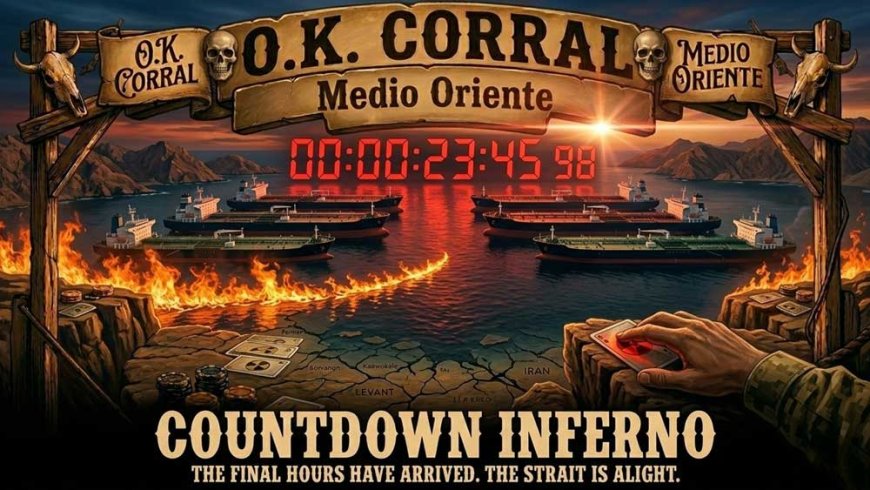
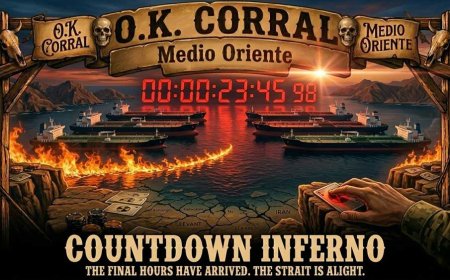
Hours left. Maybe minutes. As the sun sets over the Persian Gulf, the world holds its breath facing a scenario reminiscent of the Old West's final gun duels: the Middle East's O.K. Corral. Only this time, instead of sheriffs and outlaws, there are nuclear superpowers, strategic maritime chokepoints, and billions of barrels of oil at stake. And unlike the movies, the ending isn't written.
Trump's Countdown: "Open It, or Hell Will Rain Down"
On March 26, U.S. President Donald Trump issued a ten-day ultimatum to Iran: reopen the Strait of Hormuz or face devastating consequences. That deadline expired Monday, April 6. And in the final hours, the tone turned incandescent. In a profanity-laden post on Truth Social, Trump threatened: "Tuesday will be the Day of Power Plants and Bridges, all in one, in Iran. There will be nothing like it!!! Open that fucking Strait, you crazy bastards, or you will live in Hell – WATCH CAREFULLY!"
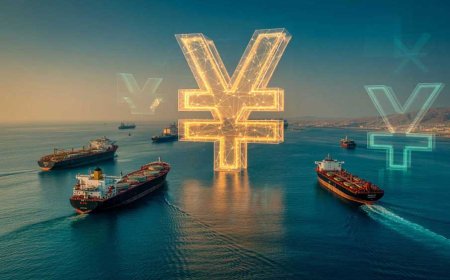
This isn't empty rhetoric. Since the conflict between the United States, Israel, and Iran exploded on February 28, traffic through the Strait of Hormuz — through which about one-fifth of the world's oil and gas transits — has practically stopped. A paralysis already shaking global energy markets.
Two Straits, One World: Hormuz and Bab al-Mandeb on the Brink of Collapse
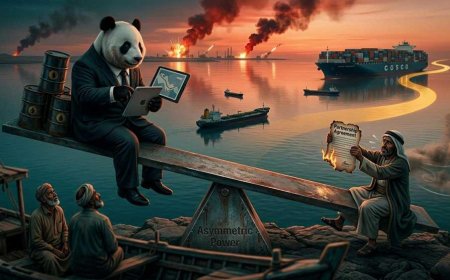
The stakes double when considering the risk of a domino effect. According to Iranian sources cited by the Tasnim agency, Tehran warned: "If the Americans want to solve the Hormuz Strait issue with stupid measures, they should be careful not to add another strait to their problems." The reference is to the Bab al-Mandeb Strait, the maritime bottleneck between Yemen and Djibouti connecting the Red Sea to the Indian Ocean and handling about 12% of global oil trade.
If both straits remain blocked, commercial routes between Europe and Asia would be forced to divert around Africa, with transit times increased by weeks and logistics costs exploding. It wouldn't just be a price problem: it would be a systemic shock for already fragile supply chains.
Fossil Fuel Dependency: The Achilles' Heel of Modern Civilization
And here's the paradox making this crisis so dangerous. Despite progress in renewable energy and commitments to the green transition, the world — and especially its transportation systems — remains dramatically dependent on fossil fuels. Ships, planes, trucks, heavy industry: almost everything moving goods and people on Earth still runs on oil or derivatives.
The International Energy Agency (IEA) has already warned: the Middle East conflict risks causing "the largest supply disruption in the history of the global oil market." And when oil becomes scarce, prices rise. When prices rise, inflation bites. When inflation bites, economies slow down. It's a vicious circle that can set entire countries back decades in terms of purchasing power and social stability.
"Back to the Stone Age": A Double-Edged Weapon
In this context, U.S. Defense Secretary Pete Hegseth's words from last week take on a sinister flavor, threatening to send Iran "back to the Stone Age." The phrase, picked up and amplified by media, hides an uncomfortable truth: in a hyperconnected and interdependent world, hitting a country's energy infrastructure doesn't isolate just that country.
If Iran were truly "sent back to the Stone Age" — with power plants, refineries, and distribution networks destroyed — the consequences would ripple outward in a chain reaction. Not just for Tehran, but for all countries dependent on its exports or who would see the entire region destabilized. And in a global economy, destabilizing an energy region means destabilizing the system.
As the UN observed: "The ongoing crisis in the Middle East is exposing a central vulnerability of the global economy: dependence on fossil fuels flowing through conflict-ridden regions." Ironically, this very vulnerability reinforces the urgency of accelerating toward more resilient and decentralized renewable energy — but the transition takes time. Time that, in these hours, seems not to exist.
The O.K. Corral Without Winners: Why the Ending Is Far from Certain
In a real O.K. Corral, in the end someone wins and someone loses. In the Middle East, in 2026, it's far from certain there will be a winner.
-
If Trump obtains Hormuz's reopening by force, he risks triggering an uncontrollable regional escalation, with attacks on civilian infrastructure that international law experts define as potential war crimes.
-
If Iran resists and maintains the closure, oil prices could shoot past $120 per barrel.
-
If Bab al-Mandeb falls in the crosshairs, global trade would suffer a blow from which it would struggle to recover for years.
And in the middle of all this, there's the human factor: Iranian civilians already living "in hell," as Trump himself admitted, and populations worldwide seeing their purchasing power erode due to a crisis that is distant but with very close consequences.
Beyond the Countdown, the Choice
The hellish countdown of these days isn't just a matter of diplomatic deadlines or military moves. It's the symptom of an energy and geopolitical model showing all its cracks.
Trump was right, in a sense he perhaps didn't intend: if the world fails to free itself from dependence on fossil fuels concentrated in conflict zones, it truly risks "going back to the Stone Age" — not by technological choice, but by systemic collapse.
The difference is that, unlike the Old West, today a faster gun isn't enough to win. A broader vision is needed. Cooperation is needed. Above all, awareness is needed that in an interdependent world, no country can afford to play Russian roulette with global energy.
The curtain on the Middle East's O.K. Corral hasn't closed yet. But as the countdown continues, the civilized world watches in shock a spectacle whose ending could rewrite — for the worse — the next decades of human history.
What's Your Reaction?








albertofattori
Alberto Fattori is an Italian venture capitalist, digital innovator, and entrepreneur with a pioneering spirit in technology and media. With a background in Computer Science, he began his career in the 1990s as CEO of Glamm Interactive, where he played a key role in developing cutting-edge digital platforms, including the official website of the Vatican (Vatican.va) and other prestigious web projects.
Over the decades, Alberto has remained at the forefront of innovation, blending creativity, business strategy, and technological foresight. Today, he is actively involved in venture capital, investing in disruptive startups across e-commerce, blockchain, phygital media, and AI-powered ecosystems.
As a founding force behind Nexth iTV+, he champions the concept of Phygital iTV, a seamless integration of physical and digital experiences across sectors such as Wine & Spirits, Fashion, Travel, and Education. Through his initiatives, Alberto promotes new models of interaction, economic cooperation, and international business—guided by a strong belief in Sharism over protectionism.
His vision is grounded in turning ideas into impactful realities by connecting capital, creativity, and technology across borders.