


























Dual Use goes to Space: when technology becomes geopolitics
Space-based data centers and orbital infrastructure are transforming from civilian tech investments into military supremacy tools. As SpaceX's opaque IPO masks the true economics, the dual-use paradigm shifts from trucks to satellites—where controlling space means controlling Earth. From the Golden Dome missile defense to the lunar resource race, the final frontier becomes the next battlefield
SpaceX's opaque IPO and the orbital database
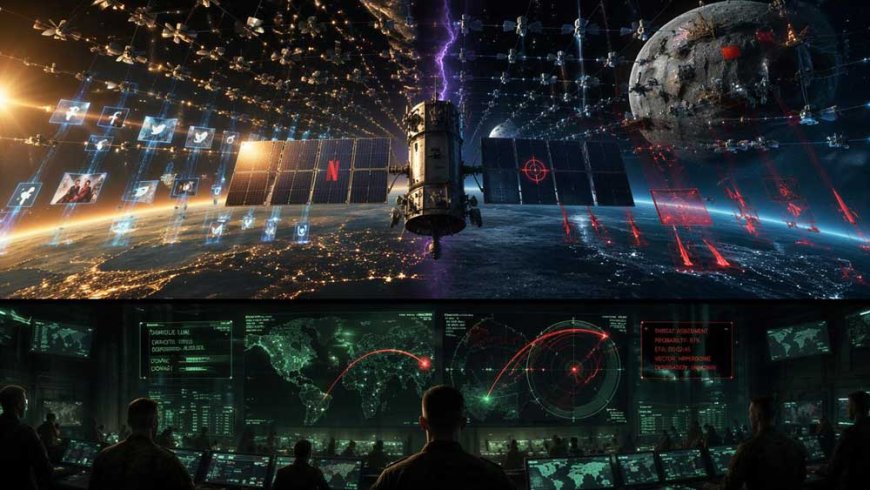
SpaceX's announcement of its intention to create a space-based database system, a constellation of one million satellites functioning as an orbital data center, arrives at a curious moment: the company's upcoming IPO is shrouded in opacity that leaves financial analysts perplexed. The numbers don't add up, launch and maintenance costs are astronomical, and the technical feasibility of such infrastructure raises more questions than answers.
But here is the paradox: what is a problem on Wall Street becomes an opportunity at the Pentagon.
Dual Use: from the road to orbit
The concept of dual use, technologies developed for civilian purposes that find military application, is certainly not new. Think of heavy-duty trucks, diesel engines, GPS navigation systems: born for commerce and transport, quickly adopted by the armed forces. Or commercial drones, now undisputed protagonists of modern war theaters.
But there is a fundamental difference. Pre-internet dual use was terrestrial, local, limited. A truck can carry troops or goods, but it cannot dominate a continent. A GPS can guide a missile or a delivery van, but its range is geographically constrained.
Space is different. Space is total.
An orbital database, or a space data center, does not serve just one nation, one theater of operations, one mission. It serves the entire planet, simultaneously. And whoever controls it can see, listen, decide, and act before anyone else.
The economic problem that becomes a strategic opportunity
Economic analysts are right when they say the costs are prohibitive: launching and maintaining one million satellites is insanely expensive. Space radiation degrades hardware irreversibly. Solar energy must compete with weight and volume constraints. And cooling — while free from the water issues of terrestrial data centers, presents immense engineering challenges.
But here is the geopolitical twist: when technology becomes an instrument of military supremacy, traditional economics stops counting.
The Trump administration's Golden Dome for America initiative, aiming to implement a layered missile defense architecture by 2029, cannot exist without space computing. James O'Brien, head of global satellite communications at U.S. Space Command, said it clearly: "I can't imagine it without [space computing]". The threat of maneuverable hypersonic missiles from China and Russia makes zero latency a matter of national survival, not economic convenience.
And when national survival is at stake, billions become budget line items, not business figures.
The New Frontier: dominating Space to dominate Earth
But there is an even deeper level. Space is no longer just a place from which to observe and communicate with Earth. It is becoming the battlefield itself.
The frantic race of recent months to establish bases on the Moon is glaring proof. China, the United States, India, Japan, Saudi Arabia, all are accelerating lunar programs with a determination that recalls the space race of the 1960s, but with a different spirit. It is no longer the conquest of the unknown; it is the occupation of the rich.
The lunar soil is full of precious materials: helium-3 for nuclear fusion, rare earths for advanced electronics, frozen water that can be split into hydrogen and oxygen for fuel. Whoever controls the Moon controls the raw materials of the future. And whoever controls the raw materials of the future controls Earth.
From borderless frontier to theater of war
There is something poetically tragic about this transformation. Space had been for decades the symbolic place of human cooperation beyond terrestrial divisions: the International Space Station, the 1967 treaty declaring space the "common heritage of mankind", dreams of exploration without borders.
Today that same frontier is militarizing at an impressive speed. The U.S. Space Force has requested $1 billion for 2027 just to build ground-based support operations centers . Commercial satellites are already legitimate targets in open conflicts, just think of the cyberattacks and anti-satellite threats that characterize current tensions. And orbital data centers, with their ability to process intelligence, guide missile defenses, and coordinate global operations, are the natural evolution of this trend.
Space, from a "peaceful place of borderless thoughts," is becoming the next frontier of conflicts between terrestrial powers. And unlike terrestrial conflicts, there are no mountains to hide behind, no borders to respect, no buffer zones. Everything is visible, everything is reachable, everything is vulnerable.
Dual Use 2.0: Space as a weapon of supremacy
21st-century dual use is no longer a truck carrying goods or ammunition. It is an orbital infrastructure that simultaneously serves civilian cloud computing and military command and control. It is a space database that hosts our streaming videos and hypersonic missile trajectories. It is a lunar solar panel that powers a scientific base or a surveillance radar.
The line between civilian and military in space is not just thin: it is nonexistent. And this makes every space investment, every satellite launched, every lunar base built, simultaneously a commercial act and a geopolitical one.
Companies like SpaceX, Google (with Project Suncatcher), NVIDIA, and Blue Origin are already dancing on this line, aware that the military market can justify investments that the civilian market would never sustain alone. It is a virtuous vicious circle: the more the military sector invests, the more technology advances; the more technology advances, the more indispensable it becomes for defense.
The Extraterrestrials? Another Chapter
And in all of this, where does the dream end? That of looking at the stars and wondering if we are alone? That of exploring the universe as a species, not as nations?
Well, that is another chapter of the story. Entirely to be written.
Because if we continue on this path, first contact, if it ever happens, will not be with peaceful explorers bringing greetings from humanity. It will be with representatives of a species divided into military factions, that has transformed Earth's orbit into a technological minefield and the Moon into a strategic outpost.
Let's hope that, when that moment comes, the extraterrestrials have a sense of irony. They will need it.
What's Your Reaction?