


























They've already beaten us!
A robot just ran a half marathon in 50 minutes and 26 seconds — beating the human world record by nearly 7 minutes. Fully autonomous. No remote control. The Beijing Humanoid Robot Half Marathon, April 19, 2026: when machines stopped chasing us and started leaving us behind. Analysis, numbers, and what this means for the future of work.
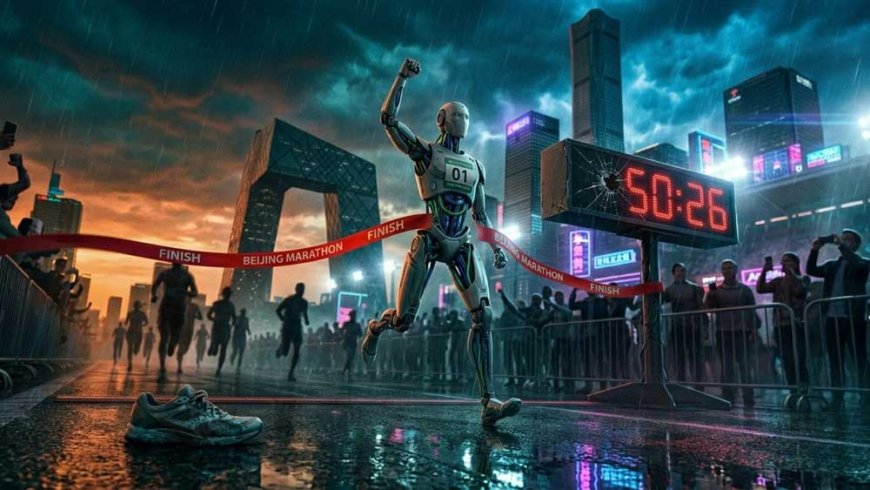
The Day the Machines crushed us: a Robot ran a half marathon in 50 minutes and 26 seconds
On April 19, 2026, in Beijing, something happened that until recently seemed impossible. A robot beat the human half marathon world record. Not by a little.
By nearly seven minutes.
The Numbers That Hurt
The robot "Lightning" (闪电) from the Qitian Dasheng (The Honor Group honors smartphone producers) team covered the 21.0975 km in 50 minutes and 26 seconds.
The human world record, set just one month earlier by Ugandan champion Jacob Kiplimo in Lisbon, stands at 57 minutes and 20 seconds. Let me do the math: 6 minutes and 54 seconds of advantage.
This isn't a close race, it's a demolition.
And it wasn't some toy remote-controlled by a guy with a joystick. "Lightning" ran in autonomous mode — it decided on its own where to place its feet, how to adjust its stride, how to handle the curves.
From 2 Hours 40 Minutes to 50 Minutes in One Year
To understand the speed of this revolution, just look back. Last year, in 2025, the winner of the first edition — robot "Tiangong Ultra" — took 2 hours, 40 minutes and 42 seconds.
In twelve months, the winning time dropped by more than threefold. This isn't progress, it's a collapse of human performance against an explosion of mechanical capability.
The Technology That Humiliates Biology
"Lightning" stands 1.69 meters tall with 95 cm legs, modeled on elite athletes. But it has something no human can have: an internal liquid cooling system that allows it to maintain consistent performance for all 21 km without succumbing to fatigue, pain, or cramps.
We sweat, we suffer, we slow down. It cools the engine and keeps pushing.
The podium was a monologue by the same company, Honor (the smartphone one): first, second, and third place all autonomous robots . The runner-up clocked 50:56, the third place 53:01. Three machines under one hour. No man on Earth has ever managed that.
"I Never Would Have Imagined Something Like This"
This is the summary of the spectators who were present at the 2025 race and who returned this year: "I feel enormous changes. It's the first time robots have surpassed humans, and it's something I never would have imagined". And more "The speed of the robots far exceeds that of humans. This might signal the arrival of a new era" .
This isn't rhetoric. It's a statement of fact.
The Shadows Behind the Triumph
Not everything was perfect. One robot fell at the starting line. Another crashed into a barrier. And there's a detail that tempers the enthusiasm: another robot from the same team, remote-controlled, crossed the finish line in 48 minutes and 19 seconds — faster than "Lightning" — but didn't win because the regulations penalize remote control with a multiplier coefficient.
The race rewards autonomy, not joysticks.
However you slice it, though, the message is clear: 47 teams out of 102 completed the race (over 45%), compared to just 6 the year before. The robots are learning to run. And they're learning fast.
What Happens Now?
The China Electronic Society called this race a "final exam" (高考) for humanoid robots preparing to enter the real world.
If a robot can run 21 km autonomously, beating the best athlete on the planet, what can it do in a warehouse? In a factory? In a hospital?
The question is no longer whether machines will replace us. The question is when. And the answer, looking at that stopwatch frozen at 50:26, seems to be: sooner than we thought.
What's Your Reaction?