







We're All in Love with Ghosts
Virtual influencers earn millions while never existing. We're trading human connection for algorithmic perfection. Are we still capable of wanting what's real? From Aitana López to PLAVE, virtual avatars are dominating entertainment and social media. This provocative analysis explores how AI-generated personalities outperform humans in engagement, why we prefer fake perfection to real imperfection, and whether authenticity still matters in a world where the artificial feels more real than reality.
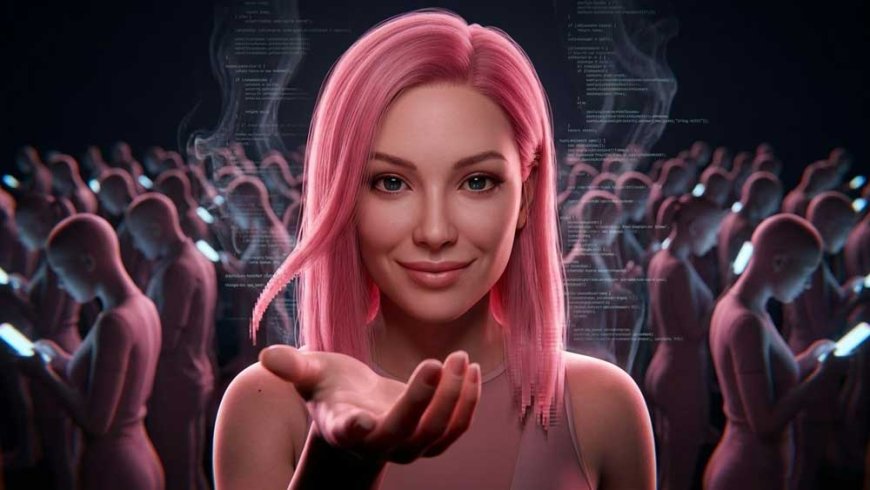
The digital epidemic devouring the last frontier of humanity: our own ability to tell real from fake
She doesn't exist. Never has. Yet she earns thousands of euros monthly sponsoring major brands. She has 392,000 people writing her "good morning" like she's a friend. She's Aitana López, a digital model/influencer with pink hair, and she's just the tip of an iceberg sinking our very idea of authenticity.
While we debate whether AI will steal jobs, the real theft has already happened: they stole our right to know who's real.
The Market of Perfect Lies
$45.88 billion by 2030. This isn't a trend—it's an industry. The virtual influencer market is growing at breakneck speed, partly because brands see them as marketing tools that are always on and highly controllable.
PLAVE, a virtual K-pop group, sold over a million copies in its first week with a recent album, proving that audiences are willing to invest real money in artists who exist only on screen.
In China, the virtual idol phenomenon is already massive: sources speak of a potential audience of hundreds of millions and intense emotional investment around these digital characters.
The Psychological Scam
You thought we connected with others through their makeup, their clothes, the stories they tell. You were wrong. We connect with what they make us feel. And AI has learned to produce exactly that sensation, on demand, never missing a beat.
Every post from Aitana is a laboratory experiment. Algorithms track your likes, measure how long you watch, analyze your comments. Then they adapt. Optimize. Refine. This isn't creativity. It's emotional engineering.
Here's the point that'll give you goosebumps: these avatars don't need to be believable as humans. They only need to be believable as vehicles of pleasure. And they are. God, how they are.
Algorithmic Empathy: The New Drug
Studies show virtual influencers outperform human ones in engagement. Not close—better. Why? Because they're available 24/7. They don't have bad days. They don't fight with boyfriends. They don't post racist rants at 3 AM. They're perfection on demand.
And we, imperfect humans, are developing something unsettling: algorithmic empathy. A form of connection requiring no reciprocity, no vulnerability, no risk of disappointment. It's love without friction. Relationship without compromise. Intimacy without the other.
Milla Sofia, the Finnish model who doesn't exist, has 578,000 followers. Some know she's fake. Others don't. Most don't care. The content is good. The aesthetic is pleasing. Why ruin the fun asking if there's a soul behind it?
So if everything's fake, will it be ignored?
The answer is no. It will be voraciously consumed.
Because the fake isn't replacing the real. It's redefining what we consider real. For a generation raised on Snapchat filters, deepfakes, and voice cloning, the distinction between "authentic" and "synthetic" has become irrelevant.
Only the experience matters. If it makes you feel something, it's real enough.
The Limits That Don't Exist (Yet)
The "uncanny valley" is still there: that point where something looks almost human but not quite, and precisely because of that, it unsettles us.
So you'd think "hyper-realistic avatars are scary!"
Wrong. That was 1970s theory. Today we've crossed the valley. Hyper-realistic avatars no longer generate discomfort. They generate desire. Neural rendering and real-time motion capture technology has made the artificial more attractive than the natural.
The only real limit is ethical, not technical. And ethics, in digital capitalism, is optional.
The Future Is Already Here, and It Has No Face (Or It Does, But It's Fake)
By 2026, AI avatars are entering schools as tutors. Nursing homes as companions. Call centers as "brand ambassadors." They're not assistants. They're replacements for human presence—cheaper, more controllable, more efficient.
And we applaud. Because they're "available 24/7." Because "they never get tired." Because "customizable on demand."
We're building a world where we prefer the artificial precisely because it's artificial. More predictable. Safer. More... comfortable.
The Question That Really Matters
It's not whether virtual avatars will replace human influencers. It's whether we'll still be capable of wanting something authentic.
When you can have a perfect relationship with an algorithm that understands you better than yourself, why bother with an unpredictable human?
When you can watch a concert where every note is pitch-perfect, every move synchronized, every interaction scripted to maximize your pleasure, why pay to see musicians who might make mistakes?
For hundreds of millions of people, the answer is: you don't anymore.
We're All in Love with "Ghosts"
Aitana López, Milla Sofia, PLAVE, and the hundreds of avatars being born this year aren't bugs in the system. They're features. They represent the logical evolution of a culture that traded authenticity for optimization, vulnerability for comfort, human connection for engagement.
You thought people wanted real people. You were wrong. People want real feelings. And if a digital ghost can produce them better than a flesh-and-blood human, the ghost wins.
The real problem isn't that AI is creating perfect avatars.
It's that we're becoming perfect consumers for avatars. Increasingly willing to suspend disbelief. Increasingly desiring fake friends who never disappoint. Increasingly accustomed to relationships without friction, content without imperfections, experiences without risk.
We're all in love with "ghosts." And the worst of these "ghosts" is the one telling us everything's fine, that it's just a trend, that human connection will never die.
As I write this, someone is commenting "you're beautiful" under Aitana's latest post. She'll respond with an emoji and a thank-you generated by a language model.
And he'll feel seen.
This is the future. This is the present. And you, patient reader, are already deciding whether this article was written by a human or an algorithm.
In the end, the answer matters less and less.
What's Your Reaction?