









China blocks the Manus-Meta Deal: the AI cold war has just begun
China blocks Meta's $2 billion acquisition of Manus AI: not just tech news, but the opening skirmish of a technological cold war fragmenting the global AI ecosystem into two incompatible spheres.
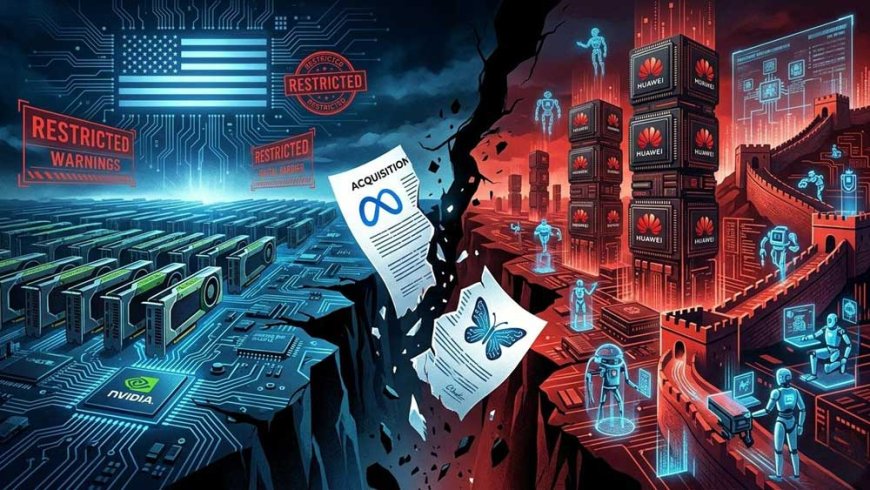
Beijing orders the dismantling of the $2 billion acquisition. It's the dawn of a new era of global technological control.
Beijing has raised the wall. In an unprecedented move marking an epochal turning point in U.S.-China technological relations, China's National Development and Reform Commission (NDRC) has officially ordered the cancellation of American tech giant Meta's acquisition of Manus, an artificial intelligence startup. The deal was valued at over $2 billion.
The official rationale, stated in a single line, cites "laws and regulations". But behind this bureaucratic phrase lies the first, true skirmish of a technological cold war that will have epochal consequences for financial markets, the AI landscape, and global geopolitical balances.
"Singapore-washing" doesn't pay off
The story of Manus is the perfect symbol of the ambiguity of this new era. Founded in China and hailed by state media as "the next DeepSeek", the company had developed what it called the world's first fully autonomous AI agent.
To escape the grip of U.S.-China tensions and attract Western capital, the founders implemented a practice known as "Singapore-washing": relocating the legal headquarters to Singapore, laying off staff in China, and relaunching as a "neutral" company.
The strategy seemed to have worked. After a $75 million funding round led by Silicon Valley's Benchmark, Mark Zuckerberg's Meta fell in love with the technology. By December 2025, the deal was closed. By March 2026, over 100 Manus employees were already working at Meta's Singapore offices.
Then the "taboo" was broken. Beijing decided that the brain drain and technology exodus had to end.
Who is Manus and why it matters
Manus is not just another chatbot app. It is a general-purpose AI agent, a system designed not to answer questions, but to execute complex tasks on behalf of the user: analyzing resumes, generating financial analysis tools, building websites, automating entire workflows. The difference compared to a "chat-based" model is the same as that between a consultant who gives you advice and an employee who directly executes the work.
The startup, created by the company Butterfly Effect, was born in China and later relocated its headquarters and core team to Singapore, a frequent move for Chinese tech companies seeking Western investors. By December 2025, the deal with Meta seemed done: over two billion dollars, employees already integrated into Zuckerberg's AI team, founders relocated to U.S. headquarters.
Then Beijing stepped in.
The Commission's Stop: The Move and The Message
The National Development and Reform Commission (NDRC), China's primary economic planning body, issued a flat ban on foreign investment in the acquisition, requiring all parties involved to withdraw from the transaction. The official statement did not mention Meta by name, but the target was unmistakable. Beijing had already defined the entire operation as a "conspiratorial" attempt to hollow out the country's technological base.
The message is crystal clear: it doesn't matter where you moved your legal headquarters. If the research was generated in China, if the founders are Chinese, if the know-how grew within the national ecosystem, that asset belongs to Chinese interests. Formal separation via Singapore may ease some commercial constraints, but it does not change Beijing's judgment on the strategic nature of the asset.
Why Meta desperately wanted Manus
In 2026, competition among major tech players is no longer measured by the quality of textual responses. It is measured by the ability to make artificial intelligence act within real-world environments: completing a purchase, managing a medical record, writing and testing code, negotiating a contract. AI agents are the next battlefield, and Meta was losing ground.
The acquisition of Manus therefore had a dual value: offensive, bringing a first-class agent in-house to integrate into the group's products, and defensive, removing it from the market before someone else could acquire it. China's stop thwarted both objectives in a single blow.
The chip war: the context that explains everything
The blocking of Manus did not occur in a vacuum. It is the mirror-image, perfectly symmetric response to what Washington has been doing for years with chips.
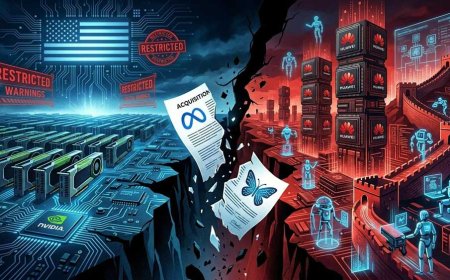
Since 2022, the United States has built a wall of export controls on advanced semiconductors to China. First, Nvidia's H100, the heart of the most advanced AI applications, was excluded from sales. Then the downgraded H20 version, developed specifically to circumvent the bans, was also blocked in early 2025. The estimated impact on Nvidia: a loss of approximately $15 billion in annual revenue, with a $5.5 billion write-down in the first quarter alone.
In the final days of his term, the Biden administration then raised the stakes further: a new Export Control Framework for Artificial Intelligence Diffusion established caps on AI semiconductor exports to approximately 120 countries, with exceptions only for 18 close allies. China's NDRC responded by denouncing "a flagrant violation of international trade rules".
The escalation did not stop there. The proposed SAFE Chips Act would freeze export rules to China for 30 months. The Match Act seeks to extend restrictions to the very machinery used to produce chips, including systems from ASML, the Dutch company that in 2025 found China to be its single largest market, accounting for over 30% of total sales. U.S. lawmakers are now calling for a total ban even on lithography equipment, eliminating any possibility of indirect access to American technology.
The boomerang effect: China builds its own supply chain
The paradox that Jensen Huang, CEO of Nvidia, has publicly denounced is this: restrictions intended to slow China are instead accelerating its technological independence.
Beijing's response to the blockade of American chips is called DeepSeek. The Hangzhou-based startup, which rose to global prominence in January 2025 with its R1 model—which caused American big tech stocks to plummet, wiping out hundreds of billions in market capitalization in a single day—has just launched DeepSeek V4. The novelty is not only in performance (the Pro version claims to be second only to Google's Gemini among frontier models). The novelty lies in the hardware: for the first time, a model of this scale has been trained and optimized on Huawei's Ascend chips, abandoning Nvidia's CUDA ecosystem in favor of China's CANN framework.
"Huawei's Ascend chips are the best domestic alternative to Nvidia, and support for DeepSeek V4 demonstrates that China's leading AI models can now run on Chinese hardware", said He Hui, semiconductor research director at Omdia. Alibaba, ByteDance, and Tencent have already placed massive orders, hundreds of thousands of units, for Huawei's next-generation chips.
The technological embargo has produced the exact opposite of its intended effect: it has created a captive market for Huawei and pushed China toward a completely self-sufficient AI ecosystem, impermeable to future U.S. sanctions.
Two mirror blocks, an asymmetric war
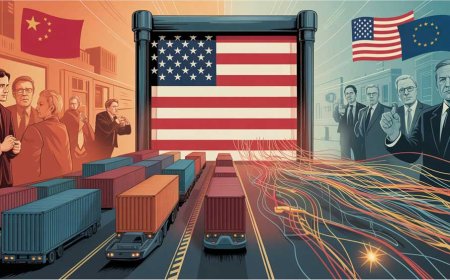
The geopolitical logic emerging from the Manus affair is that of two superpowers building complementary, mirror-image walls.
The United States blocks hardware: no advanced chips, no machinery to produce them, no access to the physical infrastructure of artificial intelligence. China blocks software and talent: no Chinese-origin AI startups sold to American players, no know-how crossing the border.
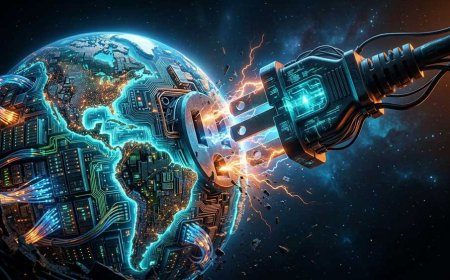
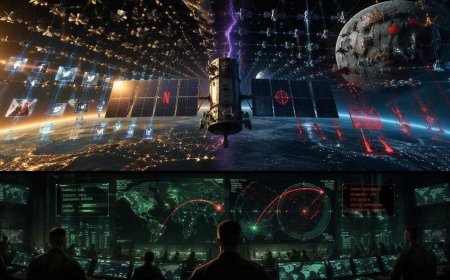
The result is a progressive fragmentation of the technological world into two separate and increasingly non-communicating spheres. It is not yet an AI iron curtain, Chinese models still circulate globally, American GPUs still reach China through alternative routes, but that is the direction. Each retaliation generates a counter-retaliation; each blockade accelerates the search for domestic alternatives.
Consequences for the rest of the World
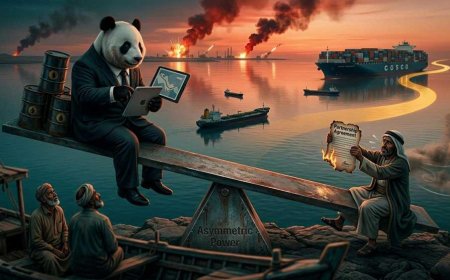
For European, Asian, and Global South companies, this technological cold war poses increasingly difficult choices. Cloud providers dependent on American GPUs find themselves navigating a regulatory labyrinth: the same licenses granted to Cerebras and Nvidia for shipments to the UAE and Saudi Arabia require mirror investments on U.S. soil, transforming every commercial agreement into an individual diplomatic negotiation.
On the opposite front, DeepSeek V4, with inference pricing reduced by 99% compared to equivalent American models, is not just a commercial offer: it is a political offer. Choosing Chinese AI means choosing an infrastructure without Washington's licenses and restrictions, but with all the implications, in terms of data privacy, geopolitical dependence, and alignment with Beijing, that such a choice entails.
The Manus case enters the precedents that every tech company with Chinese roots will need to evaluate before any future international acquisition. Singapore is no longer a sufficiently neutral refuge. The nationality of founders, the history of activities in China, the data flows generated before relocation: everything matters, everything is scrutinized.
Financial consequences: the market changes face
The immediate effect of the blockade has been renewed volatility in the technology sector, but the situation is far more nuanced than it appears. We are witnessing an AI-driven "Great Dispersion".
According to a BlackRock analysis, for the first time in a decade, the software and semiconductor sectors are no longer moving in tandem. While the software sector has lost approximately 30% since the beginning of the year (pricing in competition from AI that writes code on its own), semiconductor stocks have risen 30%, hitting new highs. The AI bubble has not burst: it is simply reassembling.
However, the blocking of Manus sends a clear signal to investors: "Beijing regulatory risk" is now a factor to consider even for transactions concluded outside national borders, affecting the perceived security of Chinese tech assets.
The game has just begun
The blocking of Manus is not an isolated episode. It is a chapter in a structural conflict that has already rewritten global value chains in semiconductors and is poised to do the same in software, data, and AI talent.
Meta will have to find its AI agent elsewhere, or build it from scratch. China has signaled that its technological excellence is not negotiable. And the world emerging from this contest, with two increasingly separate AI ecosystems, two parallel hardware supply chains, two sets of incompatible rules, will be very different from the open, interconnected world that seemed the natural destiny of the internet just twenty years ago.
The blocking of Manus is only the tip of the iceberg. Sources reveal that Beijing is considering drastic limitations on American investments in Chinese tech startups, requiring companies (such as the well-known Moonshot AI) to reject U.S. funding unless explicit prior approval is granted.
The stated objective is twofold:
- Ending the Brain Drain: Stopping the hemorrhage of talent. A study by the Carnegie Endowment found that 87 of the top 100 Chinese AI researchers remain in the United States after their training. Beijing can no longer afford this.
- Technological Sovereignty: Preventing Chinese intellectual property from being "given away" to Meta, Google, or OpenAI. As Alfredo Montufar-Helu of Ankura China Advisors states: "China is saying it will prevent foreign acquisition of assets it considers important for national security, and AI is clearly one of these".
A "splendid" isolated race
The order to divest (an exceedingly rare measure for an acquisition already concluded) means that Meta may have to resell Manus to a new buyer or to previous investors, a complex logistical and financial process given that technological integration has already begun.
This event marks the end of the unified global AI ecosystem. The world is entering a phase of technological "splendid isolation". On one side, the West seeks to lock in its advantages in semiconductors; on the other, China uses the leverage of its domestic market and capital to retain talent and IP.
The AI Cold War has officially begun. It began the day a Singapore-based company discovered it could not escape Beijing's long shadow, and the day Meta realized that, in the AI era, borders matter more than dollars.
And unlike the first Cold War, this one is fought not only with missiles and ideologies, but with chips, algorithms, and patents.
What's Your Reaction?