





























Italy, Land of Champions: A Sociological Analysis of the Sinner-Antonelli Phenomenon
Italy, Land of Champions: The Sinner-Antonelli Phenomenon. A sociological analysis of Sinner and Antonelli's success: how two champions are reshaping Italian national identity through meritocracy and humility.
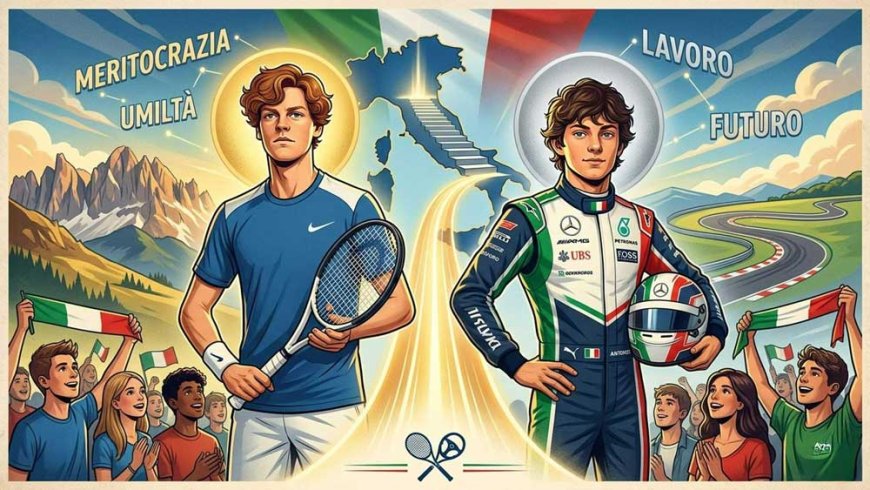
Beyond Sport: A Mirror of Contemporary Italian Society
The triumphs of Jannik Sinner and Kimi Antonelli are not merely athletic achievements—they represent a profound sociological phenomenon that reflects and accelerates cultural, economic, and identity transformations in contemporary Italy. This duo of champions is reshaping how Italians perceive themselves and their role in the world.
Meritocracy as the New National Myth
The Contrast with Football
In an Italy historically afflicted by clientelism and recommendations (raccomandazioni), Sinner and Antonelli embody pure meritocracy. Mauriello of Meritocrazia Italia recently stated: "In Italian sport there is meritocracy, but not everywhere. In tennis there is plenty, in football no" .This distinction is crucial: while Italian football suffers from a structural crisis linked to the lack of a shared developmental project and the absence of a true technical identity , individual successes demonstrate that when the system rewards talent and hard work, Italy knows how to win.
The Model of Silent Work
Both champions share an approach based on silent work, millimetric pressure management, and precocious competitive maturity . Sinner is known for his almost monastic discipline; Antonelli has been described as "precociously adult" by Mercedes team principal Toto Wolff . This model contrasts sharply with the rhetoric of the "factor C" (campanilismo, connections, clientelism) that has characterized much of recent Italian history.
The Economy of Identity: From Product to National Brand
The Economic Value of the Symbol
According to a study by Susini Group STP, the "Sinner Brand" is worth €8.1 billion to the Italian economy . This impact goes far beyond the tennis player's personal earnings (€41 million in 2024):
- The Italian tennis market has grown by 900% in twenty years
- FITP registered members have exceeded 1.15 million (+266% since 2020)
- Enthusiasts have risen to 16.9 million (+86% since 2016)
- Tennis/padel schools have increased by 34%
But the most significant figure is the return on investment: for every euro invested in tennis, the community receives €5.3 in direct and indirect benefits . This demonstrates that sport, when functioning as a meritocratic system, becomes a real engine of economic development.
"Umisostenibility": A New Value Paradigm
University professors Matteo De Angelis and Cesare Amatulli, authors of the book "The Sinner Effect", coined the term "umisostenibility"—a fusion of humility, sustainability, and modernity . Sinner embodies a sustainable leadership model that contrasts with ostentation and status symbols:
- Understatement instead of exhibitionism
- Elegance rather than loudness
- Silent discipline against empty rhetoric
This model resonates particularly with Generation Z (approximately 9 million Italians aged 13-28), which demonstrates virtuous behaviors and attention to sustainability . Young Italians are seeking authentic models, and Sinner-Antonelli offer exactly this: success without tricks, glory without scandals.
The New Geography of Champions
From Team Sports to Individual Sports
Italy is experiencing a symbolic shift from football (team sport, collective, often associated with scandals and disappointments) to individual sports (tennis, F1, athletics). This change reflects:
- Positive individualism: in an era of institutional crisis, individual champions offer direct identification without mediation
- Technology as an equalizer: Sinner and Antonelli compete in high-technology disciplines where Italy excels
- Globalization without loss of identity: both are world citizens who maintain strong Italian roots
The "New Italy": Multiethnic and Inclusive
The Sinner-Antonelli phenomenon fits into a broader context: Italian athletics has for years been a laboratory of integration, with champions like Marcell Jacobs (son of a Texan father and Italian mother), Yeman Crippa (adopted from Ethiopia), Zaynab Dosso (born in Ivory Coast) .Sinner (from South Tyrol, with strong regional identity) and Antonelli (from Bologna, son of a former racing driver) represent territorial continuity that integrates with this new multicultural physiognomy of Italian sport. National pride is no longer tied to blood, but to merit and cultural belonging.
The Role of Media: Construction of a Collective Myth
The National Dedicatory
The symbolic moment of March 15, 2026, when Sinner dedicated his Indian Wells victory to Antonelli by writing his name on the camera lens , represents a collective rite of passage. The media amplified this gesture, creating a narrative of solidarity between champions that transcends competition.
Fandom as Group Therapy
In an Italy marked by economic crises, political instability, and widespread pessimism, sporting success offers a collective emotional release valve. The 2023 ATP Finals attracted 6.6 million television viewers ; Sky Sport viewership in 2024 grew by 121% .These numbers are not just commercial indicators: they testify to a need for positive heroes, success stories not tied to politics or economics, but to individual sacrifice and talent.
Impact on Generation Z: Alternative Life Models
The SMASH Framework
Academic analysis has identified five pillars of the "Sinner model" :
- Sustainability (Sostenibilità)
- Modernity (Modernità)
- Affect (Empatia)
- Sustainable Behavior (Comportamento etico)
- Humility (Umiltà)
This framework offers Italy's Generation Z (approximately 8-9 million people ) an alternative to traditional Italian success models (rampant entrepreneur, politician, television personality). It is a model that says: you can reach the top while maintaining your integrity, your sobriety, your connection to your origins.
Education as a Value
Sinner is known for having completed his studies despite his competitive commitments; Antonelli comes from a family environment that prioritized technical and human formation. This represents a strong pedagogical message: sport is not a shortcut, but a path of complete growth.
Toward a New National Identity
The Sinner-Antonelli phenomenon goes beyond sport because it touches existential themes of contemporary Italy:
- The search for a new national pride: after football and political disappointments, Italy finds in individual champions a source of positive identification
- The rediscovery of meritocracy: when the system works, Italy produces global excellence
- The model of soft modernity: not aggressive, not arrogant, but determined and successful
- The integration between tradition and innovation: both champions maintain strong ties to their territories (Val Pusteria, Bologna) while competing globally
As Sandro Susini, founder of Susini Group, wrote: "The 'Sinner Phenomenon' is configured as a strategic investment for Italy's future. He is not just an athlete who wins tournaments, but an economic and social ambassador who contributes to transforming our country into a global sporting power" .In an era hungry for positive models, Sinner and Antonelli offer Italy not only victories, but a proposal of identity: that of a country that can compete with the world's best without betraying its values of humility, work, and passion.
Today, as Antonelli leads the Formula 1 World Championship and Sinner dominates world tennis, their simultaneous reign at the top suggests we may be witnessing only the beginning of a new era for Italian champions.
What's Your Reaction?