


















The 98th Academy Awards (2026): A Chinese Perspective Analysis
Analysis of the 98th Academy Awards through Chinese media and audience perspectives, examining the growing cultural disconnect, muted microphone controversy, and why Hollywood's biggest night is losing 1.4 billion viewers. Chinese audiences barely noticed the 2026 Oscars. This analysis explores the "deserted" social media landscape, the K-POP Demon Hunters controversy, and what Hollywood's fading relevance in China reveals about global cultural power shifts.
A Growing Disinterest
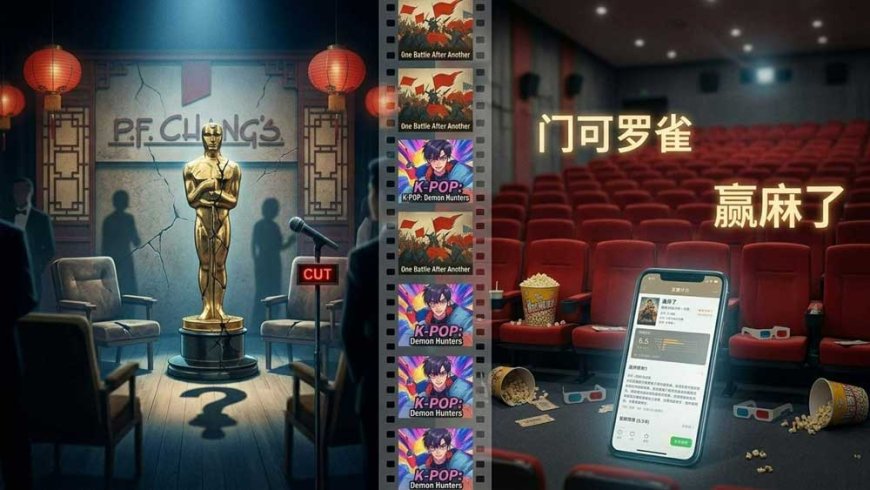
The 98th Academy Awards ceremony, held on March 15-16, 2026, confirmed an increasingly evident trend: Chinese public interest in the Oscars is declining dramatically. As reported by Huxiu, Chinese social media was "deserted" (门可罗雀) regarding the ceremony, with online engagement significantly lower than in previous years. If in 2025 there were at least "voices of protest" about "Anora's" victory, in 2026 the most common reaction was simply: "《一战再战》赢麻了" (The film won big).
The Winners and Chinese Reactions
"One Battle After Another" (一战再战) — The Evening's Dominator
Paul Thomas Anderson's film conquered 6 awards (Best Picture, Director, Adapted Screenplay, Supporting Actor for Sean Penn, Editing, and the new Best Casting award), becoming the big winner.
Douban Rating: A Misunderstood Masterpiece?
-
Douban Score: 8.1/10 — Considered a masterpiece by many Chinese critics, but with a clear generational divide
-
Criticism of political messaging: The film, which addresses themes of far-right/left politics, white supremacy, and identity politics through black comedy, was described as "a mirror of divided American society". However, many ordinary Chinese viewers found it "confusing and embarrassing" (一头雾水和尴尬)
-
The problem with "politics-speak": One critic noted that the film uses yellow as a political metaphor to mock both liberal and conservative ideologies, but this dark humor "is interesting for those who understand Hollywood cinema, but makes you regret bringing children to see it" for the general public
-
Intellectual debate: Among Chinese cinephiles, the film generated in-depth discussions. Writer Jiang Fangzhou appreciated its critique of the "left paralyzed in time" and the inefficiency of political movements, while others criticized the "rushed and messy" ending (匆匆忙忙,连滚带爬)
"Sinners" (罪人) — Record Nominations, "Flop" in Wins
With 16 nominations (a historic record surpassing "Titanic's" 14), Ryan Coogler's film won only 4 awards, becoming the "king of losers". Chinese media noted how the film, which addresses themes of racial oppression, slavery history, and the KKK, received a cold reception in China despite featuring Chinese cultural elements (Sun Wukong and Chinese opera in a bar scene).
"The Unstoppable Now" (至尊马蒂) — The "Sweet Tea" Disaster
The Timothée Chalamet film received 9 nominations but 0 wins, becoming "the biggest Oscar tragedy" (奥斯卡最大惨案).
-
Impact on the Chinese market: The film had a China release date set for March 20, 2026, with a marketing strategy based on winning expectations. After winning zero awards, box office projections crashed from 200-300 million yuan to 50-100 million (a 50%+ drop)
-
The "Sweet Tea becomes Bitter Tea" meme: The image of Chalamet forcing a smile during the ceremony went viral, with the wordplay between "甜茶" (Sweet Tea) and "苦茶" (Bitter Tea)
-
Chalamet's "gaffes": Host Conan O'Brien mocked his previous ballet statements: "Security has been tightened tonight, for fear that the ballet community might launch an attack"
The "K-POP: Demon Hunters" Case — The Victory That Split Chinese Audiences
Netflix Animation's Surprise
The Korean animated film won Best Animated Feature and Best Original Song ("Golden"), becoming the first streaming animated film to win an Oscar.
Contrasting Reactions in China
| Aspect | Positive Reaction | Negative Reaction |
|---|---|---|
| K-POP Culture | Recognition of Korea's global influence | Accusation of "sacrificing artistic quality for commercial traffic" |
| Douban Score | 6.5/10 considered low | Many users said "I really didn't like it" (真心觉得不好看) |
| Disney Comparison | Victory for cultural diversity | "How can K-POP beat Disney?" — defeat of "Zootopia 2" (4.5+ billion yuan in China) |
| Acceptance Speech | Pride in Asian representation | The "muted microphone" scandal |
The "Muted Microphone" and Double Standard Accusations
The most discussed incident was the interruption of the acceptance speech by the "Golden" team:
-
The team of 6 creators (of Korean descent) was giving thanks when background music started playing after only 40 seconds
-
The third speaker, Yu Han Lee, was abruptly cut off while about to read the thank-you list, with the camera switching to distant shots and the audience forced to leave during the commercial break
-
The damning comparison: The previous year, Adrien Brody spoke for 5 minutes and 36 seconds (a record); this year, Amy Madigan spoke for nearly 3 minutes. The "Golden" team was interrupted after less than a minute
Chinese media defined this as "double standards" (双标) and "racial discrimination" (种族歧视), with Korean netizens asking: "Is it too much to ask to speak when you win?"
Stage Design: "It Looks Like a Chinese Restaurant"
An unexpected discussion point was the ceremony stage design:
-
Many international viewers (including Chinese) compared the set design to the American Asian-fusion restaurant chain PF Chang's
-
Social media comments: "It looks like the decoration of an Asian restaurant xddd"
-
Others called the design "ugly" or compared it to a "sushi restaurant"
While not specifically "Chinese" but rather a general perception among Asian viewers, this added an element of cultural irony to the ceremony.
Chinese Cinema and the Oscars: Absence and Reflections
The Absence of Chinese Candidates
-
"Nezha 2" (哪吒2) — The film that grossed over 15 billion yuan in China voluntarily withdrew from participation. The production company stated: "Audience recognition is the highest honor"
-
"The Legend of Hei 2" (罗小黑战记2) — Although on the preliminary list, it received no nominations
The Debate: "Are the Oscars Necessary?"
Chinese media analyzed the issue with a critical perspective:
"The K-POP success at the Oscars provides an answer: Korean cinema and music conquered the world following the path of cultural export first, awards recognition after. Korean pop culture spent decades building a solid foundation... When a work like 'K-POP: Demon Hunters' appears, it's time to harvest the fruits in abundance."
The question posed was: "Can Chinese films generate large-scale discussions among non-Chinese abroad? Can our pop culture symbols be spontaneously pursued by foreign youth?"
Trends and Chinese Media Observations
1. The "Fading Hollywood Magic"
Chinese critics note that the Oscars are losing their appeal because:
-
Aesthetic fracture: Awarded films are increasingly "political niche" rather than mass entertainment
-
Impossible marketing: Films like "One Battle After Another" are difficult to promote in China because they require deep knowledge of American politics
-
Lack of "emotional connection points": Unlike "Anatomy of a Fall" (2024), which found a Chinese audience through gender themes, the 2026 films lack "resonance points" with local audiences
2. Politicization as Defensive Strategy
Some analysts see the selection of winners as a reaction to the Academy's credibility crisis:
"The 2020s Oscars seem to privilege an approach of 'being seen' rather than 'solving'. Giving voice to certain groups through emotional narratives, but often stopping at 'being seen', not at 'being solved'"
3. The Success of "Niche Cinema"
Despite the general decline in interest, Chinese media noted that:
-
The Norwegian film "Sentimental Value" (情感价值) — winner of Best International Feature — was quickly acquired for Chinese distribution by Jia Zhangke's company, with a release scheduled for late March
-
The Brazilian film "I'm Still Here" (密探) announced its China release for March 27, leveraging Oscar visibility
A Cultural Bridge Under Reconstruction
The 2026 Oscars reflect a painful transition in the relationship between Hollywood and Chinese audiences:
-
Growing disinterest: The Chinese public has moved from being a "spectator from the shore" (隔岸观火) to no longer even being interested in "watching the excitement" (看热闹)
-
Critique of "selective political correctness": The "muted microphone" incident reinforced the perception of racial double standards at the Academy
-
Strategic reconsideration: Chinese film professionals are beginning to see the Oscars not as a goal to achieve, but as "an opportunity to buy at the bottom" (抄底) to understand trends and market niches
-
The K-POP lesson: Korean success is interpreted as proof that the path to international recognition passes through building a global pop culture before participating in awards
As one analyst summarized: "The Oscars are not the cause, but the result. The question is not whether to 'storm the Oscars', but whether our cultural symbols can be spontaneously loved by foreign youth."
What's Your Reaction?








albertofattori
Alberto Fattori is an Italian venture capitalist, digital innovator, and entrepreneur with a pioneering spirit in technology and media. With a background in Computer Science, he began his career in the 1990s as CEO of Glamm Interactive, where he played a key role in developing cutting-edge digital platforms, including the official website of the Vatican (Vatican.va) and other prestigious web projects.
Over the decades, Alberto has remained at the forefront of innovation, blending creativity, business strategy, and technological foresight. Today, he is actively involved in venture capital, investing in disruptive startups across e-commerce, blockchain, phygital media, and AI-powered ecosystems.
As a founding force behind Nexth iTV+, he champions the concept of Phygital iTV, a seamless integration of physical and digital experiences across sectors such as Wine & Spirits, Fashion, Travel, and Education. Through his initiatives, Alberto promotes new models of interaction, economic cooperation, and international business—guided by a strong belief in Sharism over protectionism.
His vision is grounded in turning ideas into impactful realities by connecting capital, creativity, and technology across borders.