











That Spring Rain Bridges Past and Present
That Spring Rain Bridges Past and Present - Discover the Qingming Festival's profound meaning: memory, filial piety, and the unbroken chain connecting generations. Explore the Qingming Festival (Tomb Sweeping Day) - 2,500 years of tradition, rituals, and values that keep Chinese culture alive through remembrance.
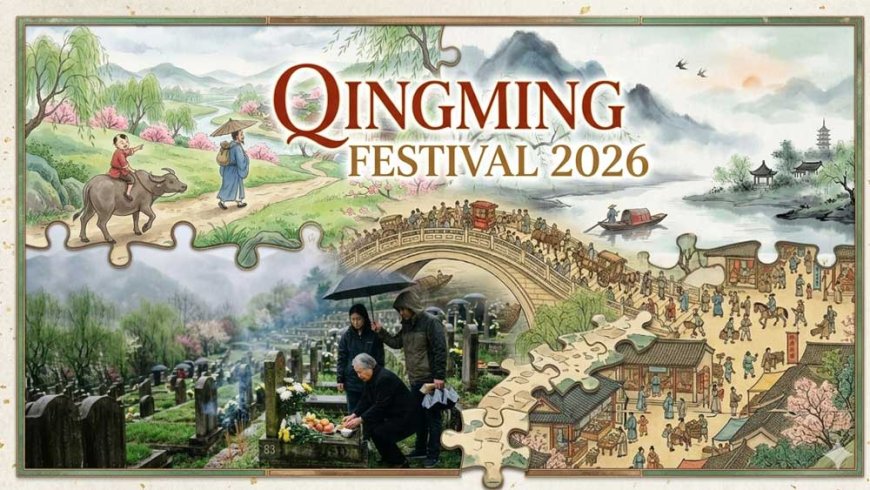
Happy Easter to all of you! Incredibly for the game of moon phases, here in Shanghai, on this year's Chinese calendar Easter coincides with the Feast of the Dead (Qingming festival).
Today, April 4, 2026, China breathes the air of the Qingming Festival
The Breath of Memory
"Every year during Qingming, that fine, dense rain transforms the deepest tears into invisible threads that traverse time."
It has come again—that time of year. The spring rain falls light, almost shy, while millions of Chinese prepare for a journey that has nothing to do with tourism. It is a pilgrimage toward the graves of their loved ones, a return to roots that digs deep into the soul.
The Qingming Festival is not merely a day on the calendar. It is an emotional bridge spanning centuries, a rope binding the living to the dead, the present to the past. When that wet rain touches the face, many can no longer distinguish whether they are drops of water or tears.
The Philosophy of Remembrance
There is a film, Coco, that touched millions of hearts with its message: "Remember me before love vanishes from memory."
The Qingming Festival is exactly this: a collective promise to not let oblivion win. The Chinese believe that final death does not occur when the heart stops beating, but when the last person who remembers you forgets your name.
That is why, every year, incense is lit. That is why paper votives are burned—even those shaped like modern smartphones or laptops—so that departed loved ones have everything they need in the afterlife. That is why flowers are brought, food is offered, and stories are told to children who never knew those vanished faces.
The Unbroken Circle
Before the tombs, families stand in silence. They clear the grass, add fresh earth, make the mound tall and mighty. It is not mere maintenance: it is an act of love that denies oblivion.
Then, the ceremony. Incense lit, ritual paper becoming ash carried by the wind, food offerings arranged with meticulous care. And the words—those words whispered or thought aloud: "We are here. We have not forgotten you. Watch over us—we are strong, we are united, and we owe this to you."
Historical Origins
Legend tells that the festival was born to commemorate Jie Zitui, a loyal follower of Duke Wen of Jin during the Spring and Autumn Period (770-476 BCE). Jie cut a piece of his own thigh to feed his lord in exile, but when the lord returned to power, he forgot to reward him.
To apologize, the Duke ordered a mountain burned to find Jie, who had retreated into solitude with his mother. Tragically, Jie and his mother died in the fire. The Duke then established the "Cold Food Festival" (Hanshi) in his honor, which later merged with the Qingming Festival.
When Pain Becomes Warmth
The Qingming Festival does not deny pain. It embraces it. It transforms it.
In Malaysia, in Singapore, in Chinese communities scattered across the world, this same scene repeats. Qingming is not merely ancestor worship. It is the moment when the extended family gathers, when grandparents' stories return to center stage, when memories become the glue for generations that might otherwise drift apart.
"I am grateful that through the Qingming Festival, our ancestors and our memories of them return to center stage, uniting the family once again."
Values That Withstand Time
The Qingming Festival embodies fundamental values of Chinese culture that resist the erosion of modern time:
慎终追远 (Shènzhōng zhuīyuǎn) — "Treat the passing of loved ones with solemnity and honor distant ancestors." This Confucian principle is the beating heart of the festival. It is not a tedious duty, but an act of gratitude toward those who laid the foundations of the present.
孝道 (Xiàodào) — Filial piety that extends beyond death, expressed through rituals that connect generations in an unbroken chain of memory.
生死观 (Shēngsǐ guān) — A view of life and death that does not fear the afterlife but accepts it as a natural part of the cycle. Qingming teaches that we are never alone: behind us lies an unbroken chain of lives that brought us here.
Today, April 4, 2026
Today, April 4th, the three-day holiday bridge begins. Highways will fill, trains will be packed, cemeteries will teem with life. But already today, the air is different. There is a silent anticipation, an emotion accumulating like clouds before rain.
And when the rain comes—that rain which the Tang poet Du Mu described a thousand years ago as "fine rain that makes the soul wish to break"—it will not be merely water. It will be the shared weeping of a nation that remembers in order to continue living, that honors the past to find courage to face the future.
The Qingming Festival only became an official national holiday in 2008, yet its essence dates back over 2,500 years. Every year, through this festival, China as a whole performs an act of collective memory that binds past to present, dead to living, individual to community.
This is the true meaning of this day: we are part of something greater, and memory is our most revolutionary act against the ephemeral.
The Cultural Code of Qingming
"祭先烈以铸国魂,敬先贤以传文脉,忆先人以固家邦,悼逝者以珍此生"
This is the cultural code that makes the Qingming Festival immortal:
-
祭先烈 — Honor the heroes to forge the soul of the nation
-
敬先贤 — Respect the sages to pass down the cultural heritage
-
忆先人 — Remember the ancestors to strengthen the family
-
悼逝者 — Mourn the departed to learn to value this life
Traditional Foods
The symbolic dish of Qingming is qingtuan (青团)—green glutinous rice balls made with mugwort or barley grass, representing the vitality of spring. In Taiwan, caozaiguo is consumed, a similar preparation based on local herbs.
What's Your Reaction?







albertofattori
Alberto Fattori is an Italian venture capitalist, digital innovator, and entrepreneur with a pioneering spirit in technology and media. With a background in Computer Science, he began his career in the 1990s as CEO of Glamm Interactive, where he played a key role in developing cutting-edge digital platforms, including the official website of the Vatican (Vatican.va) and other prestigious web projects.
Over the decades, Alberto has remained at the forefront of innovation, blending creativity, business strategy, and technological foresight. Today, he is actively involved in venture capital, investing in disruptive startups across e-commerce, blockchain, phygital media, and AI-powered ecosystems.
As a founding force behind Nexth iTV+, he champions the concept of Phygital iTV, a seamless integration of physical and digital experiences across sectors such as Wine & Spirits, Fashion, Travel, and Education. Through his initiatives, Alberto promotes new models of interaction, economic cooperation, and international business—guided by a strong belief in Sharism over protectionism.
His vision is grounded in turning ideas into impactful realities by connecting capital, creativity, and technology across borders.