










The Great Restructuring: how China is rewriting the future of its Universities
China's unprecedented university reform: 12,200 programs cancelled, 10,200 new ones created. From embodied intelligence to low-altitude economy, how Beijing is reshaping higher education to serve its strategic ambitions
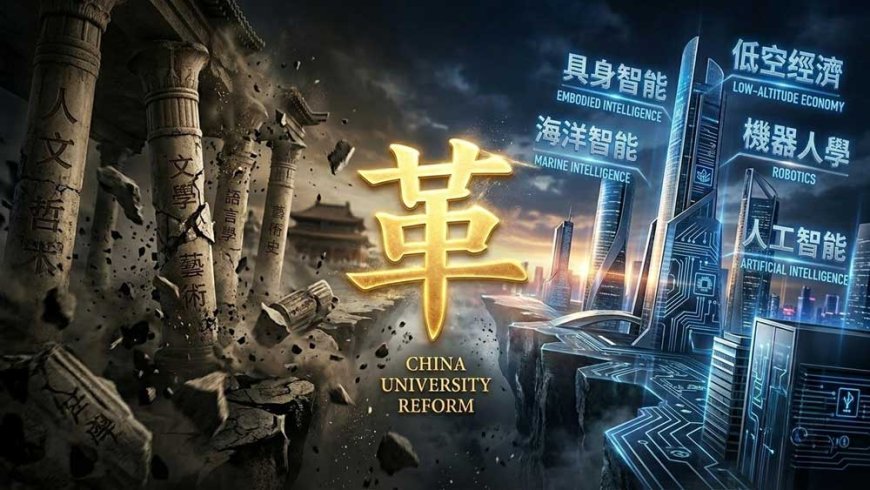
Between historic cuts and new technological frontiers, Beijing is reshaping higher education to serve the country's strategic ambitions
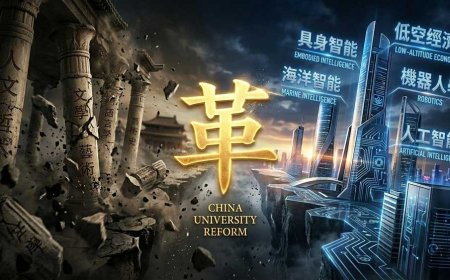
In March 2025, China's Ministry of Education released figures that border on the incredible: 12,200 undergraduate programs cancelled or suspended and 10,200 new programs established in just four years, from 2021 to 2025. More than a third of the entire Chinese academic landscape has been remade. Vice Minister Wu Yan did not mince words, calling the reform "unprecedented in scope and intensity".
But behind these numbers lies far more than a simple bureaucratic reorganization. China is making a radical strategic choice: sacrificing the breadth of educational offerings on the altar of industrial precision.
The Problem: an economy that sprints, an education system that limps
For decades, the dizzying expansion of China's university system was an engine of social mobility. Millions of young people left rural areas to earn degrees that promised a better future. But that promise has cracked.
In 2023, youth unemployment exceeded 16%, a historic peak that forced Beijing to suspend publication of the data altogether. Millions of recent graduates found themselves with degrees in arts, foreign languages, management, or journalism — disciplines that once seemed like open doors to the middle class, but now collide with a saturated and transforming labor market.
The government's message is clear: the country no longer needs more people with generic degrees. It needs people with specific skills, immediately deployable in the industries China intends to dominate.
The Axe: what disappeared
The cuts were not random. Analyzing the Ministry's data, a precise profile of the reform's victims emerges:
- Arts and humanities programs: music, dance, fine arts, and design drastically reduced
- Foreign languages: English, Japanese, Russian, and other language programs suspended at dozens of universities
- Management and marketing: degrees considered too theoretical and poorly aligned with real demand
- Traditional computer science: even technical courses, if deemed "generic," were merged or eliminated
The goal is to eliminate "overlap" — that phenomenon where dozens of universities offered identical programs with no competitive distinction, producing waves of indistinguishable and often unemployable graduates.
The Construction: the new pillars of Chinese Academia
If the axe fell on one side, China opened an accelerated "green channel" for disciplines considered strategic on the other. And here enter courses that sound like science fiction novel titles, but are already academic reality:
- Embodied Intelligence
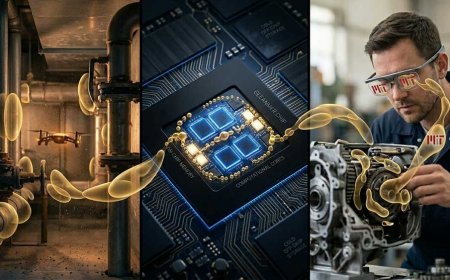
This is not simple artificial intelligence. Embodied intelligence is the intersection of AI, robotics, and physical interaction with the real world — robots that don't just "think," but act. At least 9 Chinese universities have already activated this program, positioning themselves at the forefront of a field Beijing considers fundamental to its global technological leadership.
- Low-Altitude Economy and Air Operations Management
When the Politburo of the Chinese Communist Party launched the development of the "low-altitude economy" in July 2024 — airspace up to 1,000 meters intended for drones, flying taxis, and urban aerial logistics — the Ministry of Education reacted in record time. Through an accelerated approval mechanism, at least 6 universities have already established dedicated programs for this new industrial frontier. This is not education following the market: it is education that anticipates the market, or rather, that builds it.
- Marine Intelligence and Unmanned Technologies
Though less documented in official data, this direction fits perfectly within the logic of the reform. China is investing massively in maritime drones, autonomous vessels, and ocean surveillance — capabilities that require ad hoc trained professionals, not generic engineers retrofitted for the role.
The Model: universities as state competency factories
What makes this reform different from any academic reorganization happening elsewhere?
In China, universities are not autonomous entities responding to student demand. They are instruments of industrial policy. The Ministry of Education explicitly asked academic institutions to align their offerings with the "needs of the country's economic and technological development" and with the "industrial and strategic priorities defined by Beijing".
This means that:
- A young Chinese person dreaming of studying philosophy or art history will find increasingly closed doors
- A graduate in "embodied intelligence" will leave university with skills the State has already decided it wants
- The labor market is not a passive reflection of education, but its active client
The question China is asking and we should ask ourselves too
"What skills will be needed in ten years? China is already trying to build them today".
It is a legitimate question, but one that needs context. The Chinese strategy rests on two assumptions that are not guaranteed:
- The ability to predict the future: Beijing is betting on sectors like the low-altitude economy and embodied intelligence. If these bets prove correct, it will have a ready and trained workforce. If it is wrong, it will have invested massive resources in obsolete skills.
- The sacrifice of individual freedom: a system that decides from above what is "useful" to study reduces students' capacity to explore, fail, discover unexpected passions. Creativity — real creativity, the kind that generates disruptive innovation — often emerges from the unexpected, not from the five-year plan.
Final thougts
China's university reform is a faithful mirror of the country's development model: centralized, rapid, brutal in its efficiency. The numbers — 12,200 programs swept away, 10,200 created from scratch — are not mere statistics. They are the materialization of a political choice: the university as an ally of the State in the race for technological supremacy.
For the rest of the world, the lesson is not necessarily to copy, but to observe carefully. Because if China is right about its bets, in ten years it will not only be more technologically advanced: it will also be the country that has already trained the generation that will make it so.
What's Your Reaction?